Stocks Data API Is Live in CuteMarkets

Viktoria Chapov
Product & Education
Stocks Data API Is Live in CuteMarkets
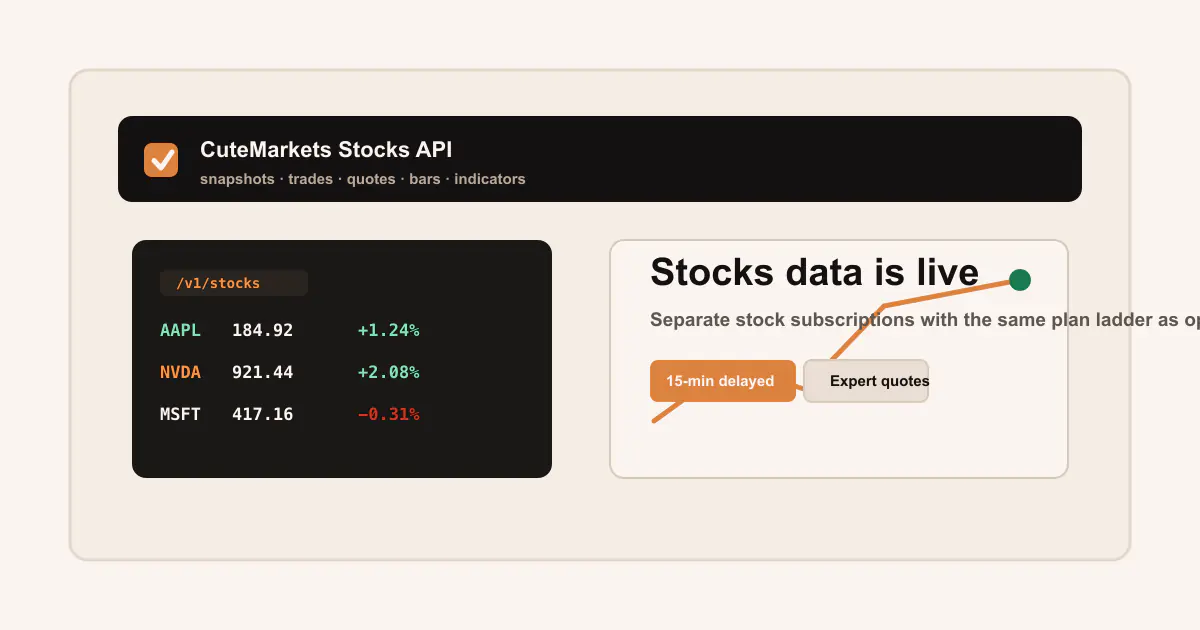
CuteMarkets stock REST data is live now. Stocks are a separate subscription product with Free, Base, Developer, Expert, and Commercial plans; Base and Developer are 15-minute delayed, while Expert adds live data plus stock quote endpoints.
Term map
Stocks-data vocabulary for this article
Separate stock snapshots, trade prints, bid/ask quotes, adjusted aggregates, ticker reference, market session, and stock/options joins. That distinction keeps stock dashboards and option-research inputs from collapsing into one vague price field.
Follow the linked definitions for Stock snapshots, Stock trades and quotes, Adjusted aggregates, Stock/options join, Access method, Freshness label, Ticker reference, Market movers, Open-close record, Stock quote entitlement, Indicator window, and Corporate-action adjustment.
CuteMarkets now supports stock REST data alongside the existing options API. The launch adds stock snapshots, movers, ticker reference, trades, quotes, aggregates, grouped bars, open-close records, and technical indicators under the /v1/stocks/ namespace.
Stocks launch as a separate subscription product, not as an automatic bundle with options. You can manage options, stocks, or both from the same CuteMarkets account, and each product keeps its own plan state.
What is live now
The new stock REST endpoints cover the core market-data workflow:
- full market snapshots, ticker snapshots, and movers
- ticker list, ticker types, ticker details, and related tickers
- historical stock trades and last trade
- historical stock quotes and last quote
- grouped bars, previous day bars, custom OHLC bars, and open-close records
- SMA, EMA, MACD, and RSI indicators
All endpoints use the same CuteMarkets response envelope with status, request_id, results, and next_url when pagination is available. The signed page cursor flow is the same one used on options endpoints.
Separate stock subscriptions
Stocks use the same plan ladder as options:
- Free: EUR 0, 10 requests per minute, 5,000 requests per day, 15-minute delayed data, 3-year lookback, no quotes
- Base: EUR 29/month with yearly billing or EUR 34/month with monthly billing, 60 requests per minute, 20,000 requests per day, 15-minute delayed data, 5-year lookback, no quotes
- Developer: EUR 49/month with yearly billing or EUR 59/month with monthly billing, unlimited requests, 15-minute delayed data, 7-year lookback, no quotes
- Expert: EUR 99/month with yearly billing or EUR 119/month with monthly billing, unlimited requests, live data, 10-year lookback, quote endpoints
- Commercial: EUR 499/month with yearly billing or EUR 589/month with monthly billing, Expert access plus commercial application allowance
Plan access is product-specific. A Developer options plan does not automatically unlock Developer stock access. A stock Expert plan unlocks stock quotes, not options quotes. The dashboard now treats them as separate subscriptions so teams can buy only what they need.
Quick example
curl "https://api.cutemarkets.com/v1/stocks/snapshot/AAPL/" \
  -H "Authorization: Bearer YOUR_API_KEY"
For historical bars:
curl "https://api.cutemarkets.com/v1/stocks/aggs/AAPL/5/minute/2026-05-01/2026-05-06/?adjusted=true&limit=5000" \
  -H "Authorization: Bearer YOUR_API_KEY"
For quote-aware stock workflows, use Expert or Commercial:
curl "https://api.cutemarkets.com/v1/stocks/quotes/AAPL/?timestamp.gte=2026-05-06T13:30:00Z&limit=1000" \
  -H "Authorization: Bearer YOUR_API_KEY"
Why this matters
Options research rarely lives alone. Stock bars, stock prints, movers, and ticker reference data are the context layer around many options workflows. With stock data now available, CuteMarkets users can keep the account, API key, authentication header, error envelope, and pagination model stable while adding the underlying equity data they need.
Integrated paper trading is next on the roadmap. This launch gives you the market-data layer: stock REST endpoints, separate stock subscriptions, and dashboard controls for managing options and stocks independently.
Start with the Stocks Data API, read the stock REST docs, or compare plans on pricing.
Related workflow
For the Stocks Data API Is Live in CuteMarkets workflow, continue through Stocks Data API, Historical Stock Data API, Stock Reference, Stock Aggregates and Indicators, Stock and Options Data Join Workflow, and Options Data API.
How the terminology applies
For Stocks Data API Is Live in CuteMarkets, the stocks data workflow should treat Stock snapshots, Stock trades and quotes, Adjusted aggregates, Stock/options join, Access method, and Freshness label as operational state rather than glossary decoration. That framing keeps stock state separate from option state so dashboards, screens, and cross-asset research do not collapse every value into one price.
A developer implementing this Product Update idea should persist Ticker reference, Market movers, Open-close record, Stock quote entitlement, Indicator window, and Corporate-action adjustment beside the result, instead of leaving those words in a term card. It also makes the stock-to-options handoff auditable because the stock timestamp and data object remain attached to downstream option requests.
The review artifact for Stocks Data API Is Live in CuteMarkets becomes more useful when Options data API, OPRA-originating data, OCC option symbol, Bid/ask spread, Midpoint, and Quote/trade condition appear in the same body of evidence as the selected rows. When the page describes a screen or watchlist, these fields should drive freshness labels, row states, and drilldown links.
In production notes for this stocks data workflow, Quote vs trade semantics, REST snapshot, WebSocket stream, Entitlement gate, Quote freshness, and Timestamp semantics define the checks that decide whether the workflow is reproducible. The result is a stock workflow that can explain whether a row came from a snapshot, bar window, trade print, quote, or reference record.
For Stocks Data API Is Live in CuteMarkets, the practical acceptance test is simple: another developer should be able to read the body, identify the exact inputs, reproduce the request sequence, and explain the accepted and rejected rows without relying on the bottom terminology grid. If a phrase appears in the page vocabulary, it should correspond to a stored field, a validation check, a replay step, or an implementation decision in the stocks data workflow.
This is also the reason the article should not measure success only by the final chart, table, or headline metric. The better standard is whether the data path, timing model, entitlement state, and evidence trail survive review. When those pieces are written directly into the body, the terminology becomes part of the workflow readers can implement.
The shorter version of this article left too much of that work implicit. The expanded version makes the hidden implementation surface visible: what gets requested first, which timestamp controls causality, which row proves market state, which row becomes a reject, and which artifact lets the result be replayed. That extra detail matters more than a longer introduction because it changes how a reader would build the workflow after leaving the page.
A useful review habit is to ask whether each paragraph names a concrete object. For this topic the objects are requests, contracts, rows, bars, quotes, trades, snapshots, cache entries, manifests, gates, and rejects. Those objects are what make CuteMarkets content useful for developers rather than only search traffic.
Stock data fields that matter in practice
The stock launch is more useful when developers treat each endpoint as a distinct market-data object. A ticker reference row is the security definition. A snapshot is current state. A trade row is a tick-level print with price, size, exchange, condition, and timestamp. A quote row is top-of-book context with bid, ask, sizes, exchange IDs, and a freshness label. An OHLCV aggregate bar is a derived summary from eligible trades, not a replacement for the quote that would explain spread or execution risk.
That separation matters as soon as a stock signal hands work to an options scanner. The stock side should carry its own schema fields: ticker, market session, adjusted flag, corporate-action adjustment, SIP timestamp, provider timestamp, and entitlement state. The option side then joins through the selected underlying, expiration, strike, and OCC option symbol. If the workflow collapses both sides into one "latest price," it loses the evidence needed to explain why a watchlist row, option chain row, or paper order was accepted.
For production users, the response envelope should also stay visible. Store request_id, pagination cursor, rate-limit budget, delayed or realtime source, and any data-quality reject. Those fields make a stock API integration easier to debug than a dashboard screenshot because they show whether the issue came from the reference dataset, the quote endpoint, an aggregate window, an entitlement gate, or the code that joined stocks to options.
The same rule applies to indicators. SMA, EMA, MACD, and RSI outputs should keep their input aggregate window, adjusted flag, timestamp, and session label. Without those fields, an indicator can drift away from the market rows that produced it.
Terminology
Market-data terms used in this article
These terms keep the article connected to the CuteMarkets knowledge base and to the exact API workflow behind the research.
Stock snapshots
Current stock state used for watchlists, movers, dashboards, and cross-product context.
Stock trades and quotes
Prints and bid/ask records that should stay separate when building spread-aware stock workflows.
Adjusted aggregates
Historical bars where corporate-action handling should be recorded before research results are compared.
Stock/options join
The workflow that ties a stock signal timestamp to listed expirations, chains, contracts, quotes, and selected option legs.
Access method
The delivery mode for market data, such as REST, WebSocket, local cache, export, or provider flat file.
Freshness label
A live, delayed, stale, historical, cached, backfilled, or unavailable state attached to a market-data value.
Ticker reference
The active status, symbol metadata, ticker type, detail, and related-ticker context checked before market data is requested.
Market movers
Snapshot-derived gainers, losers, and active symbols used for watchlists, monitors, and alert candidates.
Open-close record
A session-level stock record useful for daily review, event studies, and baseline chart context.
Stock quote entitlement
The plan boundary that decides whether bid/ask quote fields are present for stock workflows.
Indicator window
The timestamped SMA, EMA, MACD, or RSI lookback that must match the underlying bars.
Corporate-action adjustment
The split, dividend, or symbol-change handling that decides whether historical stock bars are adjusted or raw.
Options data API
The product surface for chains, contracts, quotes, trades, aggregates, Greeks, IV, open interest, and expirations.
OPRA-originating data
The U.S. listed-options source context behind quotes, trades, exchange participation, and consolidated option-market records.
OCC option symbol
The exact option contract identifier that preserves root, expiration, call or put side, and strike.
Bid/ask spread
The execution interval between bid and ask that determines whether a contract is realistically tradable.
Midpoint
The computed center between bid and ask, useful as a reference price but not proof that an order would fill.
Quote/trade condition
The condition-code, exchange, correction, sequence, and timestamp context that explains how a quote or trade row can be used.
Quote vs trade semantics
The distinction between executable bid/ask markets, printed transactions, and bar-level summaries.
REST snapshot
A reproducible request for current or historical market state, used for initialization, backfills, and audit logs.
WebSocket stream
A persistent live connection that needs subscription topics, reconnect tracking, freshness labels, and REST repair paths.
Entitlement gate
The product, plan, quote, live, delayed, historical, or commercial-use boundary checked before data is shown.
Quote freshness
The age, timestamp, and live or delayed state of a bid/ask record before it is used in a scanner, backtest, or UI.
Timestamp semantics
The exchange, provider, ingestion, session, and application time context attached to a market-data record.
FAQ
Related questions
Does CuteMarkets now have a stocks data API?
Yes. CuteMarkets now supports stock snapshots, movers, ticker reference, trades, quotes, aggregates, open-close records, and technical indicators under `/v1/stocks/`.
Are stocks included with an options subscription?
No. Stocks and options are separate subscriptions. They share the same CuteMarkets account, but each product has its own plan tier and product-scoped API keys.
Written by
Viktoria Chapov
Product & Education
Viktoria writes the approachable side of CuteMarkets: product updates, practical tutorials, market context, and beginner-friendly API workflows.
Product links
Build the workflow with CuteMarkets
This article is part of the broader CuteMarkets product and research stack. Use the landing pages below to move from the blog into the specific API workflow you want to evaluate.
Beginner options path
Send newcomers to the beginner path for calls, puts, chains, Greeks, IV, and risk.
Options Data API
See the main options overview for real-time and historical options data.
Historical Options Data API
Inspect the historical contracts, quotes, trades, and aggregates workflow.
Options Chain API
Go straight to chain snapshots, expirations, and strike discovery.
Pricing
Review plans before you move from free evaluation into production usage.