Stock Trades vs Stock Quotes API for Developers

Daniel Ratke
Research & Engineering
Stock Trades vs Stock Quotes API for Developers
A stock trade is a completed print, while a stock quote is a displayed bid/ask market. Developers should keep trades, quotes, aggregates, snapshots, and entitlement labels separate before building watchlists, research tools, or stock-plus-options workflows.
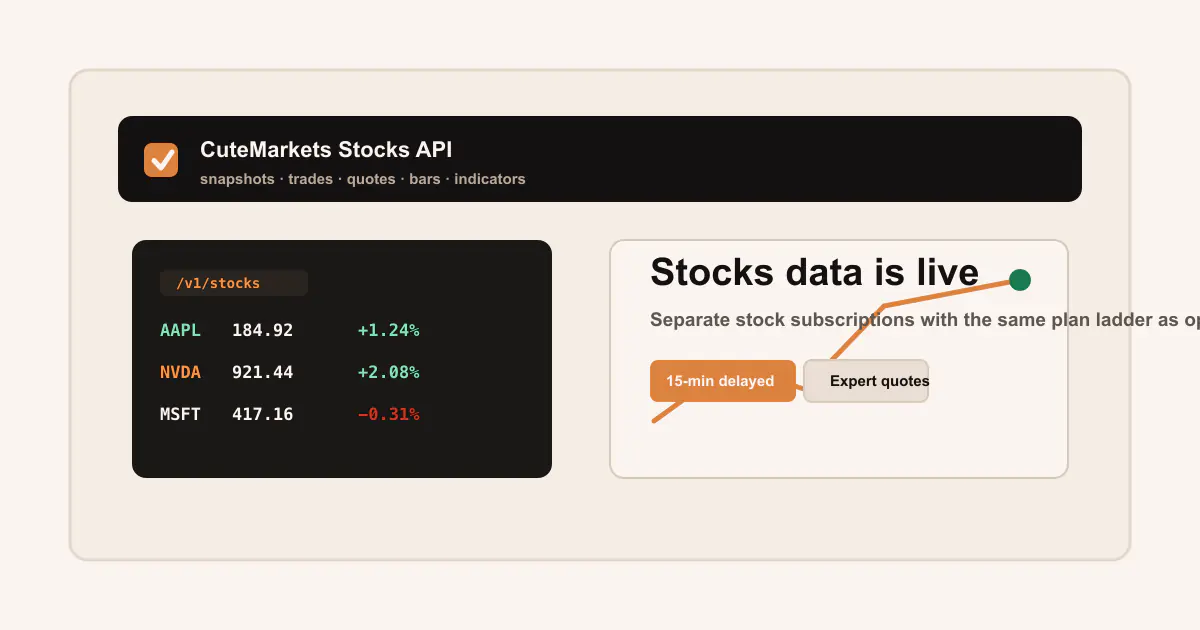
Term map
Stocks-data vocabulary for this article
Separate stock snapshots, trade prints, bid/ask quotes, adjusted aggregates, ticker reference, market session, and stock/options joins. That distinction keeps stock dashboards and option-research inputs from collapsing into one vague price field.
Follow the linked definitions for Stock snapshots, Stock trades and quotes, Adjusted aggregates, Stock/options join, Access method, Freshness label, Ticker reference, Market movers, Open-close record, Stock quote entitlement, Indicator window, and Corporate-action adjustment.
Stock data conversations often collapse everything into "price." That shortcut is dangerous for developers. A Stock Trades API, a Stock Quotes API, a Stocks Data API, and a Historical Stock Data API all expose price-related objects, but they answer different questions.
A stock trade print says a transaction occurred. A stock quote says what bid and ask were displayed. A stock aggregate says how prices summarized over a bar. A stock snapshot says what a dashboard currently knows. When those terms blur, backtests, dashboards, and support tickets become much harder to debug.
The terminology layer
Use this vocabulary before comparing providers or writing a scanner:
| Term | Practical meaning |
|---|---|
| Trade print | A completed transaction with a timestamp and price |
| Last trade | The latest observed print for a ticker |
| Quote | A bid/ask record for a ticker |
| Last quote | The latest observed bid/ask state |
| Bid/ask spread | The distance between bid and ask |
| Quote age | How old the quote is when a decision reads it |
| Aggregate | OHLC bar, often used for charts and signals |
| Snapshot | Current state object for watchlists and dashboards |
| Entitlement | The plan boundary that controls live, delayed, quote, or historical access |
The Stock Trades and Quotes docs, Live, Delayed, and Entitlements, and Stock Data Provider Evaluation belong in every implementation path.
Trade prints are realized activity
Trades are useful when you need to know what actually printed. A research system can inspect stock trades around an earnings release, a halt reopen, a VWAP break, a news spike, or a signal timestamp. A live dashboard can show the last trade as a compact activity indicator. A backtest can compare trade activity with stock aggregates and indicators to make sure a bar-derived conclusion is not hiding a thin tape.
curl "https://api.cutemarkets.com/v1/stocks/trades/AAPL/?timestamp.gte=2026-06-04T13:30:00Z&limit=1000" \
  -H "Authorization: Bearer YOUR_API_KEY"
Trade terminology to log:
- trade timestamp
- trade price
- trade size
- ticker
- request window
- pagination cursor
- live or delayed state
- product plan
The common mistake is treating a last trade as a current market. A last trade may be stale. It may print away from the current bid/ask. It may be useful for activity, but it does not prove what a quote-aware application could buy or sell at that moment.
Quotes are displayed markets
Quotes are the right layer when bid/ask context matters. A spread-aware dashboard, an execution review, a customer-facing trading tool, or a stock-plus-options strategy should know whether it used a quote, a trade, or a bar.
curl "https://api.cutemarkets.com/v1/stocks/quotes/AAPL/?timestamp.gte=2026-06-04T13:30:00Z&limit=1000" \
  -H "Authorization: Bearer YOUR_API_KEY"
In CuteMarkets, stock quote endpoints require Expert or Commercial stock access. That plan boundary keeps "real-time stock data" from being misread when the application also needs quote history or last quote checks. The Real-Time Stock Data API, Stock Quotes API, and Pricing pages make that distinction explicit.
Quote terminology to log:
- bid
- ask
- midpoint
- spread amount
- spread percent
- quote timestamp
- quote age
- quote entitlement
- last quote source request
For options workflows, the same discipline appears in Options Quotes docs, Why Option Quotes Matter More Than Last Price, and Backtesting Execution Realism.
Bars are signal context, not fill evidence
Aggregates are useful for charts, technical indicators, opening ranges, moving averages, and historical research. They are not a substitute for trades or quotes when a workflow needs tick-level or bid/ask evidence.
A common flow is:
- Use Stock Aggregates and Indicators for the signal.
- Use Stock Trades API to inspect realized activity near the signal.
- Use Stock Quotes API when bid/ask context matters.
- Use Options Data API only after the stock event has a timestamped reason to inspect an option chain.
That sequence prevents same-bar lookahead. If a stock bar closes at 13:50:00Z, the option workflow should not claim an option fill at 13:47:00Z unless the order existed before the bar closed. The Stock and Options Data Join Workflow and same-bar fills guide explain this problem in more detail.
How to choose the endpoint
| Developer question | Better endpoint | Why |
|---|---|---|
| What currently belongs on a watchlist? | Stock snapshots | Snapshot state is compact and dashboard-friendly |
| What printed after the news? | Stock trades | Trade history shows realized activity |
| What bid/ask market was displayed? | Stock quotes | Quote history supports spread-aware checks |
| What was the five-minute bar path? | Stock aggregates | Aggregates support chart and signal logic |
| What option should the strategy inspect? | Options chain | Chains select candidate contracts after the stock event |
The provider comparison should run each question separately. If the provider has trades but not quotes, that may be fine for tape review and weak for bid/ask dashboards. If it has bars but not clean reference data, a scanner may still break on symbol lifecycle issues.
Stock-plus-options example
A stock signal becomes an options workflow only after it has a timestamp:
{
  "underlying": "AAPL",
  "stock_signal_timestamp": "2026-06-04T14:35:00Z",
  "stock_object": "adjusted_5_minute_aggregate",
  "stock_trade_window": "2026-06-04T14:35:00Z/2026-06-04T14:40:00Z",
  "stock_quote_required": true,
  "option_next_step": "load_expirations_then_chain"
}
The next page in that path is Stock and Options Data Joins for Strategy Research, followed by Options Chain Scanner Architecture and Historical Options Replay Runbook if the workflow becomes a backtest.
Provider evaluation checklist
When evaluating stock trades and quotes, ask:
- Are trades and quotes separate endpoint families?
- Is quote access gated by plan?
- Are live and delayed states named in product labels?
- Are pagination cursors documented?
- Can historical timestamps be filtered cleanly?
- Are aggregates adjusted or raw, and is that flag visible?
- Can the stock signal join to an option chain, contract, quote window, and replay artifact?
That is a stronger comparison than asking whether a provider has a stock price API. Developers do not integrate "a price." They integrate reference data, snapshots, trades, quotes, bars, indicators, entitlements, and support paths.
How the terminology applies
For Stock Trades vs Stock Quotes API for Developers, the stocks data workflow should treat Stock snapshots, Stock trades and quotes, Adjusted aggregates, Stock/options join, Access method, and Freshness label as operational state rather than glossary decoration. That framing keeps stock state separate from option state so dashboards, screens, and cross-asset research do not collapse every value into one price.
A developer implementing this API Guide idea should persist Ticker reference, Market movers, Open-close record, Stock quote entitlement, Indicator window, and Corporate-action adjustment beside the result, instead of leaving those words in a term card. It also makes the stock-to-options handoff auditable because the stock timestamp and data object remain attached to downstream option requests.
The review artifact for Stock Trades vs Stock Quotes API for Developers becomes more useful when Options data API, OPRA-originating data, OCC option symbol, Bid/ask spread, Midpoint, and Quote/trade condition appear in the same body of evidence as the selected rows. When the page describes a screen or watchlist, these fields should drive freshness labels, row states, and drilldown links.
In production notes for this stocks data workflow, Quote vs trade semantics, REST snapshot, WebSocket stream, Entitlement gate, Quote freshness, and Timestamp semantics define the checks that decide whether the workflow is reproducible. The result is a stock workflow that can explain whether a row came from a snapshot, bar window, trade print, quote, or reference record.
For Stock Trades vs Stock Quotes API for Developers, the practical acceptance test is simple: another developer should be able to read the body, identify the exact inputs, reproduce the request sequence, and explain the accepted and rejected rows without relying on the bottom terminology grid. If a phrase appears in the page vocabulary, it should correspond to a stored field, a validation check, a replay step, or an implementation decision in the stocks data workflow.
This is also the reason the article should not measure success only by the final chart, table, or headline metric. The better standard is whether the data path, timing model, entitlement state, and evidence trail survive review. When those pieces are written directly into the body, the terminology becomes part of the workflow readers can implement.
Terminology
Market-data terms used in this article
These terms keep the article connected to the CuteMarkets knowledge base and to the exact API workflow behind the research.
Stock snapshots
Current stock state used for watchlists, movers, dashboards, and cross-product context.
Stock trades and quotes
Prints and bid/ask records that should stay separate when building spread-aware stock workflows.
Adjusted aggregates
Historical bars where corporate-action handling should be recorded before research results are compared.
Stock/options join
The workflow that ties a stock signal timestamp to listed expirations, chains, contracts, quotes, and selected option legs.
Access method
The delivery mode for market data, such as REST, WebSocket, local cache, export, or provider flat file.
Freshness label
A live, delayed, stale, historical, cached, backfilled, or unavailable state attached to a market-data value.
Ticker reference
The active status, symbol metadata, ticker type, detail, and related-ticker context checked before market data is requested.
Market movers
Snapshot-derived gainers, losers, and active symbols used for watchlists, monitors, and alert candidates.
Open-close record
A session-level stock record useful for daily review, event studies, and baseline chart context.
Stock quote entitlement
The plan boundary that decides whether bid/ask quote fields are present for stock workflows.
Indicator window
The timestamped SMA, EMA, MACD, or RSI lookback that must match the underlying bars.
Corporate-action adjustment
The split, dividend, or symbol-change handling that decides whether historical stock bars are adjusted or raw.
Options data API
The product surface for chains, contracts, quotes, trades, aggregates, Greeks, IV, open interest, and expirations.
OPRA-originating data
The U.S. listed-options source context behind quotes, trades, exchange participation, and consolidated option-market records.
OCC option symbol
The exact option contract identifier that preserves root, expiration, call or put side, and strike.
Bid/ask spread
The execution interval between bid and ask that determines whether a contract is realistically tradable.
Midpoint
The computed center between bid and ask, useful as a reference price but not proof that an order would fill.
Quote/trade condition
The condition-code, exchange, correction, sequence, and timestamp context that explains how a quote or trade row can be used.
Quote vs trade semantics
The distinction between executable bid/ask markets, printed transactions, and bar-level summaries.
REST snapshot
A reproducible request for current or historical market state, used for initialization, backfills, and audit logs.
WebSocket stream
A persistent live connection that needs subscription topics, reconnect tracking, freshness labels, and REST repair paths.
Entitlement gate
The product, plan, quote, live, delayed, historical, or commercial-use boundary checked before data is shown.
Quote freshness
The age, timestamp, and live or delayed state of a bid/ask record before it is used in a scanner, backtest, or UI.
Timestamp semantics
The exchange, provider, ingestion, session, and application time context attached to a market-data record.
FAQ
Related questions
Is a last trade the same as a stock quote?
No. A last trade is the latest observed print. A quote is bid/ask market context and can require a different plan entitlement.
When should a stock workflow use quotes instead of trades?
Use quotes when the workflow needs bid/ask spread, quote age, midpoint, last quote, or execution-quality context rather than only realized prints.
Written by
Daniel Ratke
Research & Engineering
Daniel covers the deeper research notes: options backtesting, execution realism, robustness testing, data engineering, and strategy validation.
Product links
Build the workflow with CuteMarkets
This article is part of the broader CuteMarkets product and research stack. Use the landing pages below to move from the blog into the specific API workflow you want to evaluate.
Stock Trades API
Use trade history and last trade records for realized stock prints and tape review.
Stock Quotes API
Use quote history and last quote records when bid/ask context and spread checks matter.
Stock Trades and Quotes Docs
Read endpoint semantics, plan boundaries, pagination, and quote-access rules.
Stock Data Provider Evaluation
Compare providers by reference data, snapshots, trades, quotes, bars, indicators, and entitlements.