cuteoptionstrats: A Public Research Note on a Curated Intraday Options Model

Daniel Ratke
Research & Engineering
cuteoptionstrats: A Public Research Note on a Curated Intraday Options Model
The main lesson from cuteoptionstrats is that a promising intraday options model still needs microstructure filters, realistic fills, trade-density checks, and portfolio gates before it can be treated as deployable.
Term map
Backtesting vocabulary for this article
Treat signal timestamp, point-in-time universe, quote-aware fill, reject reason, replay artifact, walk-forward test, and cache key as first-class terms. They separate reproducible research from a backtest that only preserves the final performance table.
Follow the linked definitions for Point-in-time contracts, Quote-aware fills, Reject reasons, Replay artifact, Cache key, Signal timestamp, Look-ahead leakage, Walk-forward test, Slippage model, Same-bar fill, Promotion gate, and Options data API.
Read this article with Options Backtesting API, Backtesting Framework, Backtesting Data Quality Checklist, Backtesting Execution Realism, Quote-Aware Options Backtests, and Backtest to Paper Trading Parity Checklist.
Repository examined: cutemarkets/cute-intraday-option-strats
Primary source document: README.md
Related engine: cutemarkets/cutebacktests
Abstract
Most public trading repositories publish either toy signals or opaque backtests. The cuteoptionstrats repository takes a different approach. It does not claim to be a full research platform, and it does not pretend that one public strategy is the whole portfolio. Instead, it exposes one curated intraday options strategy, c36_quality, as a thin public wrapper around the larger cutebacktests research engine. That design choice reveals the strategy family, the causal assumptions, the option-quality filters, and the evaluation framework used to judge whether a model belongs in the research queue.
The central model in the repository is a quote-aware 0-2DTE VWAP mean-reversion strategy on liquid U.S. index ETFs, with a target expiry of 1DTE and a default universe of SPY and QQQ. The package makes a narrow promise: it packages one public alias, preserves the model metadata, exposes a small CLI and Python API, and maps local environment variables into the underlying runtime. The README is unusually explicit about the signal lineage, entry conditions, stop and target construction, exit hierarchy, option microstructure constraints, and the metrics used to evaluate the strategy in the wider research stack. That transparency is more useful than a generic "AI trading" claim because it lets readers inspect what is actually being standardized.
This post summarizes what the public repository tells us, what the strategy is really doing, where the public artifact ends and the research engine begins, and why the published results are more interesting for their methodological honesty than for headline performance alone.
Research question
What exactly is being published in cuteoptionstrats, and what can a technically serious reader infer from it about intraday option strategy design, packaging, and evaluation?
A second question matters just as much. If the public repository only packages one model, does it still reveal enough to be scientifically useful? In this case, the answer is yes. The package is small, but the public README and code surface reveal five things clearly:
- the strategy family and profile lineage
- the exact signal and exit logic at a meaningful level of detail
- the option-side quality assumptions
- the metrics used to judge robustness in the larger stack
- the distinction between a public wrapper and the underlying research engine
That last point is important. A large share of retail-facing quant content confuses packaging with research. This repository does not. It says directly that cutebacktests remains the source of truth for the generic engine, profile definitions, option selection, quote handling, and persistence, while cuteoptionstrats acts as an opinionated public entrypoint.
The public artifact: what the repository actually contains
As inspected on April 21, 2026, the repository is intentionally compact. The public package consists of:
- a
README.md - a
pyproject.toml - a single source package under
src/cuteoptionstrats - one public test file under
tests/test_public_surface.py
The source package itself is only a small set of files:
That structure tells us this is not a "public from scratch" backtester. It is a packaging layer over a deeper research system. The dependency list in pyproject.toml confirms the design: the only runtime dependency is cutebacktests>=0.2.0. The public package deliberately exports one stable research lane rather than duplicating the entire internal engine.
Scientifically, this is sound packaging. It reduces the surface area for public drift. If the public package reimplemented the strategy logic separately, it would create two risks: divergence between the "real" research profile and the public version, and silent differences in fill logic or data handling. By pinning the public package to the same engine, the authors reduce those risks. The tradeoff is that readers must understand the public repository as a control surface, not the full machinery.
The published model
The repository exposes one default model:
- default model id:
c36_quality - backing profile:
c36_vwap_mr_option_native_quality_v1 - signal family: VWAP residual z-score mean reversion
- instrument expression: single-leg options
- DTE window:
0-2DTE - target expiry:
1DTE - default universe:
SPY,QQQ
The lineage described in the README is especially important:
c4_mr_vwap_zscore_v2c4_mr_vwap_zscore_v2_fastc18_vwap_mr_balance_v1c18_vwap_mr_quality_v1c36_vwap_mr_option_native_quality_v1
This is not cosmetic naming. It implies that the public strategy is the result of iterative refinement along two dimensions. First, the signal family was shaped around VWAP residual mean reversion. Second, the execution layer evolved from a more generic underlying-driven setup into an option-native implementation with explicit quote and contract quality assumptions. A reader should not think of c36_quality as a single inspired idea. It is a descendant of a branch-and-filter research process.
The core signal: VWAP residual mean reversion
At the signal level, c36_quality is conceptually simple and structurally disciplined. The strategy computes an intraday VWAP, defines residuals as close - VWAP, estimates a rolling standard deviation of those residuals over a 20-bar window, and converts that deviation into a z-score. The strategy then looks for excursion and reclaim behavior rather than raw breakout continuation.
The active timing parameters are not arbitrary:
- opening range context uses the first
5bars - signal evaluation begins at
09:35 - new entries stop at
12:00 - hard exit is at
15:55 - maximum hold is
25minutes - opposite-candle exit can trigger after
3minutes
This makes the strategy a morning-to-midday reversion system rather than an all-day mean-reversion engine. That distinction is important. Intraday VWAP reversion strategies degrade quickly if they are allowed to chase late-session noise, especially in options, where spread conditions and gamma exposure can worsen as the day progresses.
The public README also makes clear that the strategy is not a blind z-score trigger. Several filters are active before a trade is accepted:
- relative opening volume must be at least
1.05 - residual volatility must remain within a bounded range
- VWAP slope over the recent lookback must not be too steep
- the signal bar must close as a reversal candle in the trade direction
- the setup must still support a valid stop and next-bar entry
That filter stack reveals a practical insight. The strategy is not trying to fade every excursion from VWAP. It is trying to fade excursions in sessions that are active enough to matter, calm enough to avoid chaos, and not trending so hard that "mean reversion" is really just stepping in front of directional flow.
Why next-bar entry matters
One of the strongest parts of the public README is that it calls out the causal assumption explicitly: signals are detected on one bar and entered on the next bar open. That sounds modest, but it is a major difference from many retail backtests, which often let the model detect and fill on the same bar in a way that is not realistically executable.
For short-horizon intraday options strategies, that distinction is even more important than it would be in equities. The option leg inherits both underlying timing error and option microstructure error. If the strategy were allowed to "teleport" into the signal bar, its performance would be structurally overstated. By documenting next-bar entry, the repository makes a strong methodological statement: the signal bar is for detection, not for fantasy execution.
Stop, target, and exit design
The stop logic combines three pieces of information:
- the signal bar extremum
- the previous bar extremum
- a VWAP residual z-score envelope
That combination is then widened by a buffer tied to opening-range width. The target is expressed in VWAP residual space, with additional normalization when the raw z-score target would otherwise be economically trivial or sit on the wrong side of entry.
This is a good example of strategy engineering rather than indicator worship. The repository is not saying "buy when z-score crosses X and sell when z-score crosses Y." It is saying that entry and exit need to respect market structure, local volatility, and the economics of the trade. The target normalization rule is particularly telling. It acknowledges that a mathematically valid target can still be too small to matter after costs and slippage.
The exit hierarchy is also explicit:
- stop loss
- z-score target
- opposite-color candle after minimum hold
- max hold time
- time exit at or after
15:55 - session-close fallback
For a public research artifact, this is a high-quality disclosure. Exit logic often hides a large share of the actual edge or overfitting in intraday systems. Here, the exit stack is clear enough for a reader to understand the behavioral profile: fast reversion capture if available, controlled damage if wrong, and a strict intraday time budget.
Option expression: why this is not "just an equity signal"
The repository states that c36_quality is the option-native version of the c18 signal family. That phrase is doing real work. The signal may originate on the underlying, but the monetization happens through the generic options runner in cutebacktests. That means the real trade is not complete until contract selection and option execution assumptions are applied.
The public option-side assumptions are:
- single-leg options only
- target expiry around
1DTE - allowed expiry window
0DTEto2DTE - quote-aware execution
- option microstructure filter enabled
- minimum option entry volume
25 - minimum option premium
0.60 - maximum option entry-bar range
35% - minimum quote coverage
35% - minimum chain coverage
35%
These filters are not ornamental. They are the difference between a tradable intraday options model and a chart-driven paper strategy that assumes infinite liquidity. Very short-dated options can look attractive on the underlying chart while being practically unusable because of sparse quotes, unstable spreads, tiny premiums, or incomplete chain data. By requiring quote coverage and chain coverage floors, the package signals that data sufficiency is part of the strategy specification, not a separate operational cleanup step.
The evaluation framework matters more than headline PnL
The README is unusually strong in its discussion of evaluation metrics. Instead of reducing the model to "win rate" or "return," it surfaces a broader research vocabulary:
Sharpe_yearlySortino_yearlyDSRPBOROIC_peakCAGR_ROIC_peak- trades per week
Two aspects stand out.
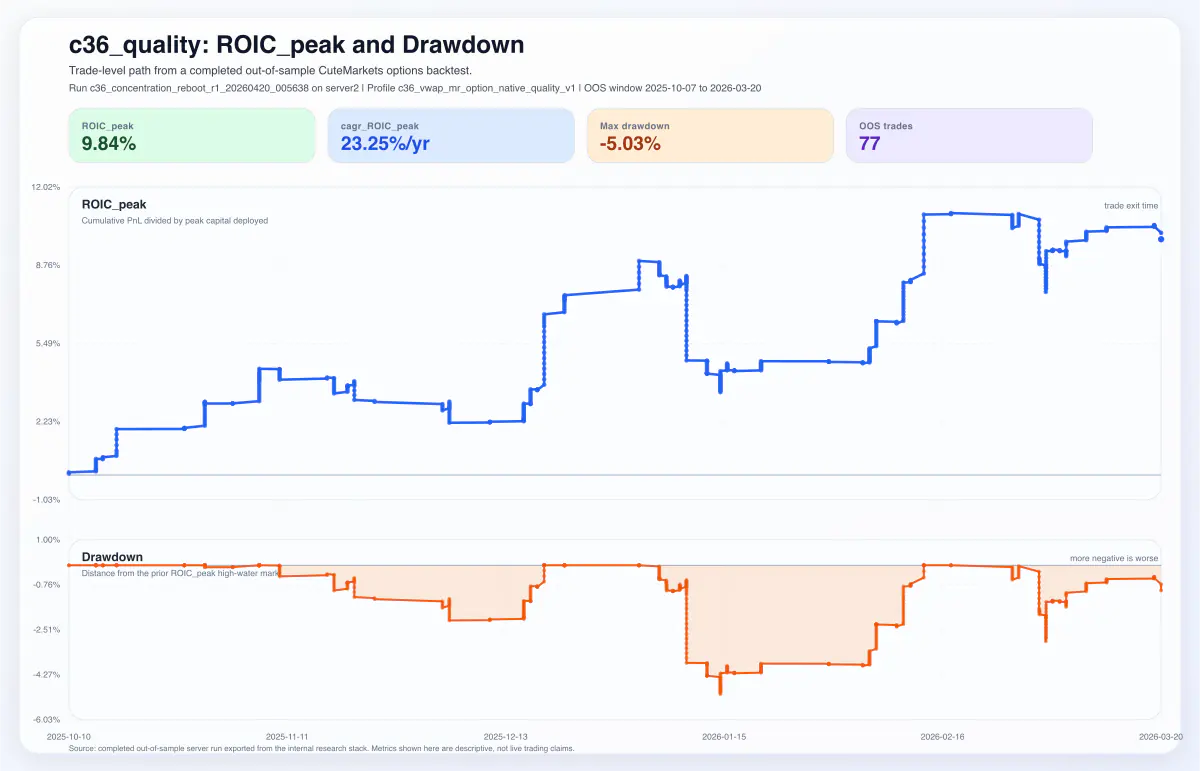
First, the repository emphasizes capital efficiency through ROIC_peak, which it defines as out-of-sample PnL divided by peak deployed capital. That is a more informative metric than raw PnL when comparing intraday option strategies with different capital footprints.
Second, it explicitly frames DSR and PBO as tools for penalizing multiple testing and overfitting. That is rare in public trading content. The broader message is methodological: the stack does not want to rank strategies by raw Sharpe or raw return alone. It wants to know whether the apparent edge survives reasonable skepticism about data mining.
That choice aligns with the rest of the repository. The package is not presenting c36_quality as a perfect model. It is presenting it as a documented public branch that passed several methodological filters, while the published comparison table still shows stronger and denser alternatives.
The most important result is actually a negative result
The public README publishes three strategy-level evidence points:
| Model | Published evidence | Interpretation |
|---|---|---|
c66_opening_compression_option_native_short_balance_dte35_v1 | base OOS return 19.18%, stress-medium 16.70%, stress-harsh 15.56%, 76 OOS trades | stronger published comparison branch |
c36_vwap_mr_option_native_quality_v1 | +16004 PnL, 15 trades, DSR 0.6400, failed only trades_per_week_ok | real but sparse runner-up; this is the packaged public branch |
c36_vwap_mr_option_native_opportunity_v1 | 85 trades, +2987 PnL | density improved, quality decayed |
The interesting point is not that c36_quality made money in one artifact set. The interesting point is that the repository says plainly that it is not the best model, and then explains why. The quality variant appears to retain signal strength but fails a trade-density gate. The opportunity variant increases activity but loses quality. That is a classic model-development tradeoff, and it is exactly the kind of negative result that many public repositories hide.
This is why the repository is useful even though it only packages one model. It shows the reader a live tension between edge quality and trade frequency. In portfolio construction, a strategy can fail not because it is false, but because it is too sparse to fill the intended portfolio role.
Published figure: capital efficiency and drawdown
The repository now also includes a visual summary of the public c36_quality branch:
This figure emphasizes the metric vocabulary described in the README. The strategy is not being framed only in terms of raw return. It is being framed in terms of capital efficiency through ROIC_peak and the path-dependent pain visible in drawdown. That is the right pairing for an intraday options model. A strategy can post positive aggregate PnL and still be operationally unattractive if the capital footprint is inefficient or the drawdown path is too unstable for the intended portfolio sleeve.
What the public tests tell us
The public test file is small, but it is informative. It does not test "alpha." It tests stability of the public contract:
- default model metadata remains stable
- the default profile resolves to the expected
c36alias - default config generation applies profile values and user overrides correctly
- repo-scoped environment aliases map cleanly onto the underlying runtime settings
That testing choice is rational. Since the package is a wrapper, its public promise is not "we prove strategy profitability in unit tests." Its public promise is "the selected model alias, configuration plumbing, and runtime mapping behave consistently." This is another sign that the repository understands what it is and what it is not.
Reproducibility surface
The repository has both a CLI and a Python API. That supports two different public workflows: a lightweight evaluation path and a more programmable research path.
CLI example
python -m cuteoptionstrats.cli show-model

python -m cuteoptionstrats.cli run-backtest \
  --ticker SPY \
  --start 2025-01-01 \
  --end 2025-01-31 \
  --return-trade-log
Python example
from datetime import datetime

from cuteoptionstrats import build_default_config, build_default_model, load_settings
from cuteoptionstrats.runtime import build_backtester
from cutebacktests.storage import DataStore

settings = load_settings(".env")
model = build_default_model()
store = DataStore(settings.db_path)

try:
    backtester = build_backtester(settings=settings, store=store)
    result = backtester.run(
        build_default_config(
            start=datetime(2025, 1, 1),
            end=datetime(2025, 1, 31),
            ticker="SPY",
            return_trade_log=True,
        )
    )
    print(model.model_id, result.get("trades"))
finally:
    store.close()
The environment model is also worth noting. The package defines repo-scoped path aliases:
CUTEOPTIONSTRATS_DATA_DIRCUTEOPTIONSTRATS_DB_PATH
These are then mapped into the underlying cutebacktests runtime configuration. That is a practical public-interface choice. It lets users work inside the public package namespace without needing to think first about the deeper engine namespace.
Scientific interpretation
From a scientific point of view, the repository supports four conclusions:
- the authors are publishing a strategy wrapper, not a toy backtester, which avoids reimplementation drift and makes the public artifact easier to reason about
c36_qualityis a real research branch rather than a marketing label, with enough README detail on lineage, active parameters, signal logic, stop/target design, option constraints, and evaluation metrics to make the strategy intelligible- option microstructure is part of the model rather than a post-hoc excuse, with quote coverage, chain coverage, option premium floors, and entry-bar range limits treated as central design choices
- the public result that matters most is not "this strategy made money," but "this strategy survived enough methodological filtering to be published, while still failing one portfolio gate because it was too sparse"
Limitations
The repository is useful, but it has clear limits.
- It is a narrow public package, not a full research environment.
- It focuses on one curated public branch rather than every explored variant.
- It depends on
cutebacktests, which means some implementation detail remains outside the public repo. - The published results are summary evidence, not a full public artifact pack with every fold and every equity curve.
- The default universe is narrow, which is reasonable for this strategy family but limits generalization.
These are not hidden weaknesses. They are explicit boundaries. In practice, that makes the repository more trustworthy than a broader but less disciplined public release would be.
Conclusion
cuteoptionstrats is a small repository, but it is not a trivial one. Its value lies in the combination of narrow scope and high disclosure. It packages one intraday options model, documents the signal family precisely, makes causal entry and option-quality assumptions explicit, and frames performance inside a research vocabulary that includes overfitting penalties and capital-efficiency measures.
For public readers, the most useful lesson is methodological. A credible intraday options repository does not need to package every explored variant. It does need to be clear about what is being wrapped, where the reusable engine lives, how trades are detected and executed, what option constraints are active, and why a model can still be interesting even if it is not the strongest portfolio anchor. On that standard, cuteoptionstrats is a strong public artifact.
References
- cutemarkets/cute-intraday-option-strats repository
- Repository README
- Public package metadata in
pyproject.toml models.pyruntime.pycli.pytests/test_public_surface.py- cutemarkets/cutebacktests repository
Related workflow
For the cuteoptionstrats: A Public Research Note on a Curated Intraday Options Model workflow, continue through Options Backtesting API, Backtesting Framework, Backtesting Execution Realism, Backtesting Data Quality Checklist, Quote-Aware Options Backtests, and Backtest to Paper Trading Parity Checklist.
How the terminology applies
For cuteoptionstrats: A Public Research Note on a Curated Intraday Options Model, the backtesting workflow should treat Point-in-time contracts, Quote-aware fills, Reject reasons, Replay artifact, Cache key, and Signal timestamp as operational state rather than glossary decoration. That framing keeps the research claim causal: the strategy can only select instruments, prices, and labels that existed at the decision time.
A developer implementing this Research Note idea should persist Look-ahead leakage, Walk-forward test, Slippage model, Same-bar fill, Promotion gate, and Options data API beside the result, instead of leaving those words in a term card. It also turns attractive performance into an auditable record where fills, skips, thresholds, and replay inputs can be challenged independently.
The review artifact for cuteoptionstrats: A Public Research Note on a Curated Intraday Options Model becomes more useful when OPRA-originating data, OCC option symbol, Bid/ask spread, Midpoint, Quote/trade condition, and Quote vs trade semantics appear in the same body of evidence as the selected rows. When a result is promoted, these fields should appear in the run manifest, rather than a prose summary or final equity curve.
In production notes for this backtesting workflow, REST snapshot, WebSocket stream, Entitlement gate, Quote freshness, Timestamp semantics, and Pagination cursor define the checks that decide whether the workflow is reproducible. The result is a backtest that can be rerun, compared across threshold families, and rejected when the evidence is not strong enough.
For cuteoptionstrats: A Public Research Note on a Curated Intraday Options Model, the practical acceptance test is simple: another developer should be able to read the body, identify the exact inputs, reproduce the request sequence, and explain the accepted and rejected rows without relying on the bottom terminology grid. If a phrase appears in the page vocabulary, it should correspond to a stored field, a validation check, a replay step, or an implementation decision in the backtesting workflow.
This is also the reason the article should not measure success only by the final chart, table, or headline metric. The better standard is whether the data path, timing model, entitlement state, and evidence trail survive review. When those pieces are written directly into the body, the terminology becomes part of the workflow readers can implement.
Terminology
Market-data terms used in this article
These terms keep the article connected to the CuteMarkets knowledge base and to the exact API workflow behind the research.
Point-in-time contracts
Contract discovery anchored to the research date so a backtest does not use future listings.
Quote-aware fills
Entry and exit assumptions based on bid/ask quotes, quote age, spread width, and side-specific fill rules.
Reject reasons
Logged explanations for skipped contracts or fills, including stale quote, wide spread, no bid, or missing data.
Replay artifact
The saved request, selection, fill, reject, and metric record that lets another developer audit the backtest.
Cache key
The structured identifier that keeps provider, endpoint, ticker, timestamp, plan, and schema state from being mixed.
Signal timestamp
The exact time a strategy made a decision, used to reconstruct the visible universe and quote window causally.
Look-ahead leakage
A research error where a fill, contract, indicator, or label uses information unavailable at decision time.
Walk-forward test
A validation method that repeatedly trains and evaluates across separated time windows instead of trusting one optimized sample.
Slippage model
A fill-cost assumption based on bid/ask side, midpoint, spread percent, quote age, and liquidity policy.
Same-bar fill
An intraday backtest assumption that can become invalid when signal, entry, stop, and target ordering is ambiguous.
Promotion gate
The written threshold that decides whether a research candidate can move into paper trading or production monitoring.
Options data API
The product surface for chains, contracts, quotes, trades, aggregates, Greeks, IV, open interest, and expirations.
OPRA-originating data
The U.S. listed-options source context behind quotes, trades, exchange participation, and consolidated option-market records.
OCC option symbol
The exact option contract identifier that preserves root, expiration, call or put side, and strike.
Bid/ask spread
The execution interval between bid and ask that determines whether a contract is realistically tradable.
Midpoint
The computed center between bid and ask, useful as a reference price but not proof that an order would fill.
Quote/trade condition
The condition-code, exchange, correction, sequence, and timestamp context that explains how a quote or trade row can be used.
Quote vs trade semantics
The distinction between executable bid/ask markets, printed transactions, and bar-level summaries.
REST snapshot
A reproducible request for current or historical market state, used for initialization, backfills, and audit logs.
WebSocket stream
A persistent live connection that needs subscription topics, reconnect tracking, freshness labels, and REST repair paths.
Entitlement gate
The product, plan, quote, live, delayed, historical, or commercial-use boundary checked before data is shown.
Quote freshness
The age, timestamp, and live or delayed state of a bid/ask record before it is used in a scanner, backtest, or UI.
Timestamp semantics
The exchange, provider, ingestion, session, and application time context attached to a market-data record.
Pagination cursor
The continuation token or next URL that keeps large chains, trades, quotes, and historical windows complete.
FAQ
Related questions
What did the cuteoptionstrats research show?
It showed that strategy quality depends on more than headline backtest returns: liquidity, quote behavior, trade density, overlap, and promotion gates all decide whether a model is usable.
Why can a profitable options model still fail promotion?
A model can fail if trades are too sparse, spreads are too wide, overlap is too high, stress behavior is weak, or the fill assumptions are too fragile for paper trading.
Written by
Daniel Ratke
Research & Engineering
Daniel covers the deeper research notes: options backtesting, execution realism, robustness testing, data engineering, and strategy validation.
Product links
Build the workflow with CuteMarkets
This article is part of the broader CuteMarkets product and research stack. Use the landing pages below to move from the blog into the specific API workflow you want to evaluate.
Beginner options path
Send newcomers to the beginner path for calls, puts, chains, Greeks, IV, and risk.
Options Data API
See the main options overview for real-time and historical options data.
Historical Options Data API
Inspect the historical contracts, quotes, trades, and aggregates workflow.
Options Chain API
Go straight to chain snapshots, expirations, and strike discovery.
Pricing
Review plans before you move from free evaluation into production usage.